Lucky 9 is the quick banker game of Filipino fiestas, wakes and break rooms: two cards, maybe a third, and whoever lands closer to 9 wins. It looks like pure luck, and mostly it is, but the one decision you do get (draw or stand) has a clear right answer once you know the numbers. This guide covers the standard rules, the house rules that change from table to table, and the exact odds behind every two-card total.
How do you play Lucky 9?
Lucky 9 uses one standard 52-card deck without jokers. One person is the banker and everyone else is a player. Each player bets against the banker only. You never compete with the other players at the table, so their hands do not affect your result.
- Bets first. Every player places a bet in front of them before any card is dealt. Many groups set a maximum so the banker can cover every bet.
- Two cards each. The banker deals two cards face down to each player and to themselves.
- Draw or stand. Going around the table, each player decides whether to take one more card. The third card is dealt face up in most games.
- Banker last. The banker decides on their own third card after every player has acted.
- Showdown. Each player’s hand is compared with the banker’s. Higher total wins, the bet is paid 1:1, and equal totals are usually a push (bet returned).
That is the whole loop. A round takes less than a minute, which is why the game moves so fast at a party table.
How are Lucky 9 cards counted?
| Card | Value |
|---|---|
| Ace | 1 |
| 2 to 9 | Face value |
| 10, Jack, Queen, King | 0 |
Add your cards and keep only the last digit. A 7 and a 5 make 12, which counts as 2. An 8 and an 8 make 16, which counts as 6. A 9 and a King make 9, the best possible hand. Because only the last digit counts, you can never “bust” the way you can in blackjack: a bad draw just wraps you around to a low number.
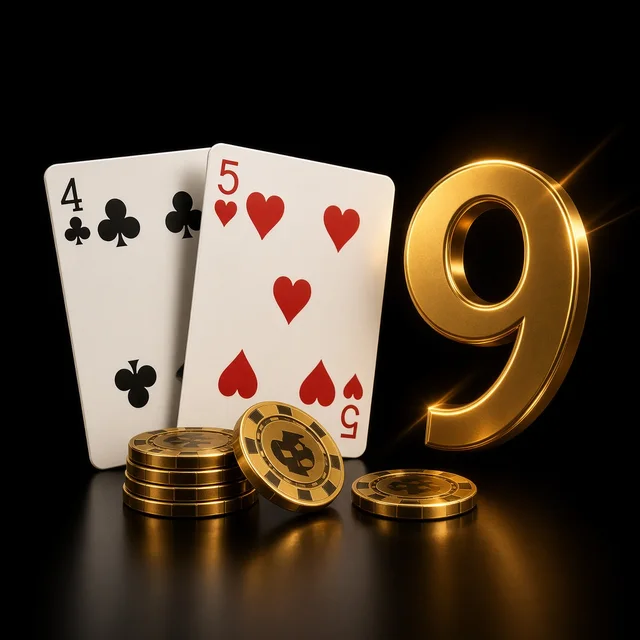
- 4 + 5 = 9
- 6 + 6 = 12 → 2
- Ace + Queen = 1
- 10 + King = 0 (the worst hand)
- 3 + 4 + 2 (three cards) = 9
Suits do not matter for the total. If you already know Dragon Tiger or baccarat, the counting will feel familiar: Lucky 9 is a simpler member of the same baccarat family.
What are the odds of each two-card total?
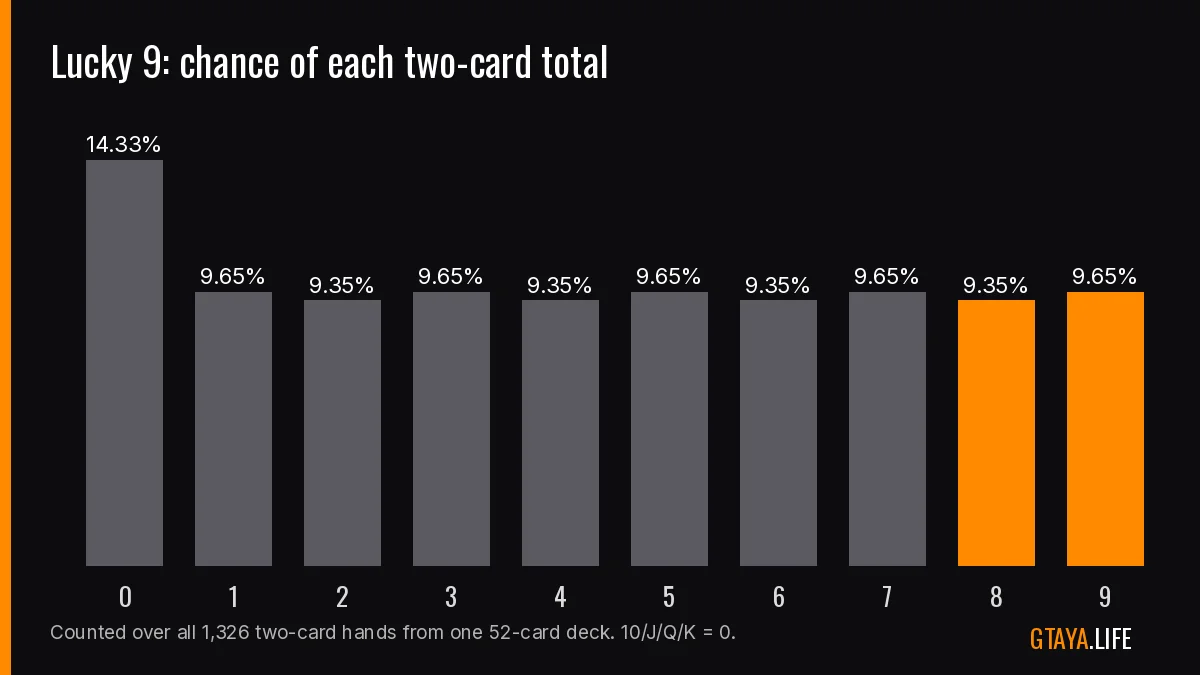
We counted every one of the 1,326 possible two-card hands from a full 52-card deck. Sixteen cards are worth 0 (the tens and face cards), so a total of 0 is the most likely result. Every other total sits close to 9.5%.
| Two-card total | Hands (of 1,326) | Chance |
|---|---|---|
| 9 | 128 | 9.65% |
| 8 | 124 | 9.35% |
| 7 | 128 | 9.65% |
| 6 | 124 | 9.35% |
| 5 | 128 | 9.65% |
| 4 | 124 | 9.35% |
| 3 | 128 | 9.65% |
| 2 | 124 | 9.35% |
| 1 | 128 | 9.65% |
| 0 | 190 | 14.33% |
So you start with a two-card 9 in roughly 1 hand out of 10, and with 8 or 9 in about 19% of hands. More than half of all starting hands (52.34%) total 4 or less.
When should you draw a third card?
This is the only real decision in the game. The third card adds 0 to 9 points to your total. About 30.8% of cards (the 16 tens and face cards) add nothing, so your total stays the same. The rest either raise your total or wrap it around past 9 to something lower.
| Your two-card total | Third card improves it | Stays the same | Makes it worse |
|---|---|---|---|
| 0 | 69.2% | 30.8% | 0% |
| 1 | 61.5% | 30.8% | 7.7% |
| 2 | 53.8% | 30.8% | 15.4% |
| 3 | 46.2% | 30.8% | 23.1% |
| 4 | 38.5% | 30.8% | 30.8% |
| 5 | 30.8% | 30.8% | 38.5% |
| 6 | 23.1% | 30.8% | 46.2% |
| 7 | 15.4% | 30.8% | 53.8% |
| 8 | 7.7% | 30.8% | 61.5% |
Figures use a full 52-card deck as an approximation; the cards already dealt shift them slightly in a real round.
The pattern is simple. At 4 or less, a draw is more likely to help than to hurt. At 5, it is more likely to hurt. At 6 and above, drawing is usually a mistake. That is why the most common table rule is “draw on 0 to 4, stand on 6 to 9”, with 5 left to the player. Some groups make the draw compulsory below a set number, and some casino versions fix the draw rule completely so there is nothing to decide. Ask before you play.
Improving your total is not the same as beating the banker, of course. A move from 2 to 5 still loses to a banker 6. The table just tells you which choice gives you the better hand more often.
What house rules change from table to table?
Lucky 9 has no official rulebook, so groups add their own bonuses. These are the ones you will meet most often. None of them is universal.
- Natural 9 bonus. A two-card 9 sometimes pays more than 1:1, or wins immediately before any third card is dealt.
- Pair or “colour” bonus. Some tables pay extra for a matching pair or two cards of the same suit.
- Three-of-a-kind bonus. A three-card hand of the same rank can pay a multiple.
- Banker wins ties. A few groups give ties to the banker instead of pushing. This is a big advantage for the banker; agree on it openly.
- Rotating banker. In home games the bank usually passes around the table after a set number of rounds or when the bank runs out.
Write the agreed rules down if new players join mid-session. Disputes in Lucky 9 almost always come from a bonus that one person thought was in play.
Is it better to be the banker in Lucky 9?
Under the basic rules (1:1 payouts, ties push), the banker and each player follow similar drawing logic, but the banker acts last and can see how many players drew. That information is a small but real edge. Any rule that gives the banker ties, or bonus payouts that only players can collect, changes the balance. There is no published, verified house-edge figure that covers every house-rule mix, so we do not quote one here. The fair approach in a home game is to rotate the bank so everyone takes turns.
What mistakes do new Lucky 9 players make?
- Counting 10 as ten. Tens and face cards are worth 0.
- Drawing on 6 or 7. The table above shows that a draw from 6 makes the hand worse almost half the time.
- Chasing a “hot” banker. Every round is a fresh deal. Past results do not predict the next hand.
- Raising bets to win back losses. In a game this fast, chasing empties a budget in minutes. Set a stop-loss before the first deal.
Which card games are similar to Lucky 9?
If you enjoy quick banker games, In Between uses the same one-deck, one-decision rhythm. For longer skill games, try Tongits or the shedding game Pusoy Dos. All our guides live in the Card Games section, and unfamiliar betting words are explained in what a casino bet means.
Playing online for real money? Only use an operator that appears on PAGCOR’s own list. Our guide shows how to verify a PAGCOR-licensed site in a few minutes. When you are ready, visit the official GTAYA site.
Frequently asked questions
What is the highest hand in Lucky 9?
A total of 9. Only the last digit of the card total counts, so 9 is the best possible hand and 0 is the worst.
How much is a King worth in Lucky 9?
Zero. The 10, Jack, Queen and King all count as 0. Ace counts as 1 and 2 to 9 count at face value.
When should I draw a third card in Lucky 9?
Draw on 4 or less and stand on 6 or more. At 5, a third card is slightly more likely to lower your total than raise it.
What are the odds of a natural 9 in Lucky 9?
From a full 52-card deck, 128 of the 1,326 possible two-card hands total 9, which is about 9.65%.
Is Lucky 9 the same as baccarat?
It belongs to the same family and counts cards the same way, but Lucky 9 is played against a banker with simpler, more flexible house rules.
About this article
Written by the GTAYA Editorial Team; reviewed 2026-11-04. Card values and the basic deal follow common published rules (see sources). All probabilities were computed by the GTAYA Editorial Team by counting every two-card combination of a 52-card deck; the third-card table uses a full deck as an approximation. Bonus payouts and drawing rules vary by group and by online version and were not verified for any specific table.

Our guides are researched from official sources (PAGCOR, BSP, Philippine law) and reviewed before publishing. Rules that vary by table are flagged.
Play on the official, PAGCOR-registered domain
Bookmark it and avoid clone sites.
Go to gtaya.com21+ only · Affiliate link